

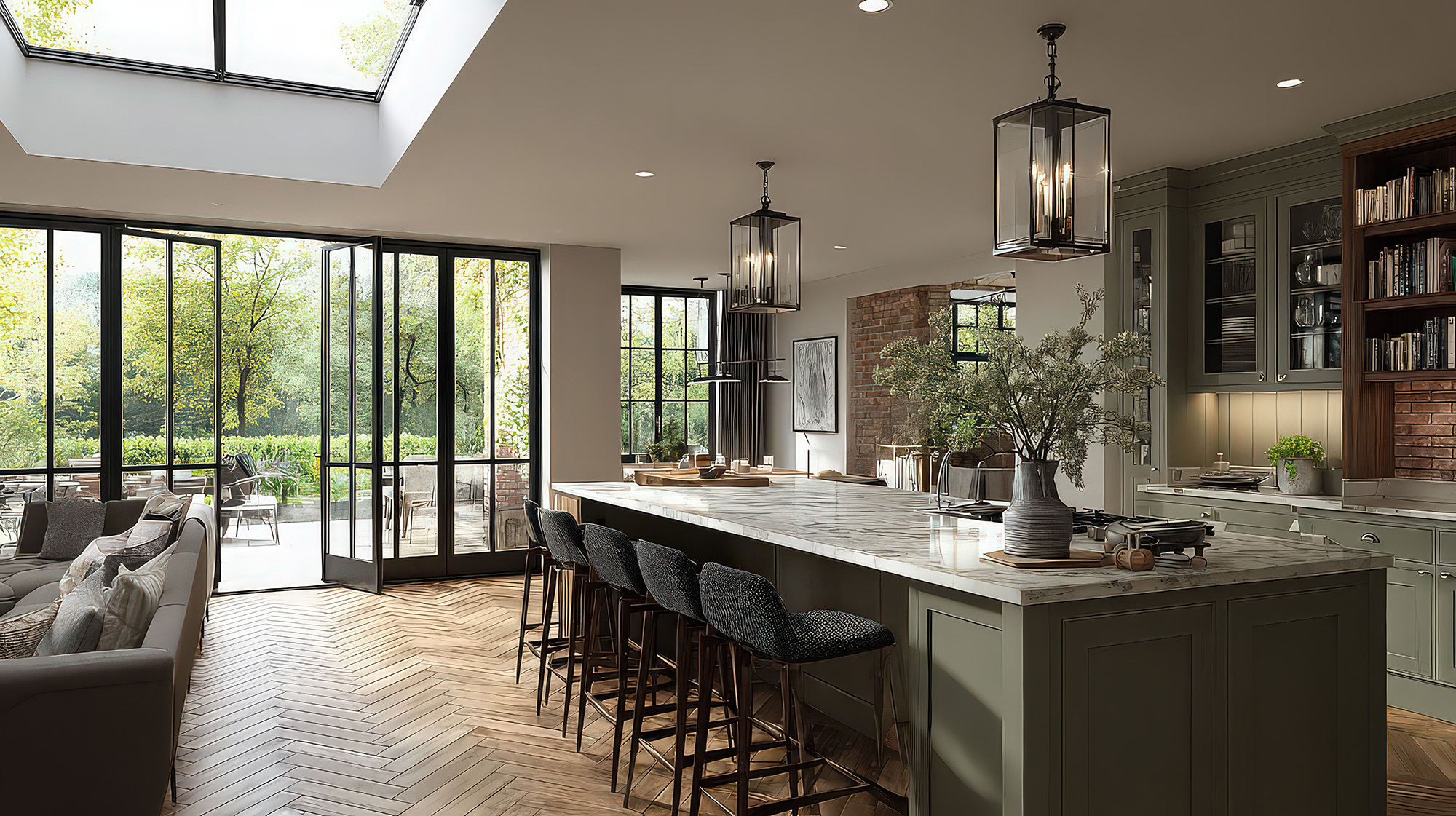
Choosing a new countertop affects the way your kitchen looks, functions, and handles daily use. Quartz countertops and granite countertops are both durable options, but they behave differently enough that the right choice depends on your priorities.
Quartz is engineered for consistency and low maintenance, while granite brings the natural variation and heat resistance of stone. Cost, maintenance, appearance, and the way you use your kitchen should all factor into the decision. Understanding those differences before countertop installation can help you choose a surface you will be happy to live with for years.
Quartz Offers Consistent Looks and Easy Maintenance
Quartz countertops are engineered from natural quartz combined with binding materials, allowing manufacturers to create consistent colors and patterns. That can make quartz especially appealing when you want a clean, predictable appearance that coordinates closely with cabinetry and flooring. Maintenance is another major advantage. Quartz is nonporous, so it does not require routine sealing like many natural-stone surfaces.
Everyday cleaning is generally straightforward, although manufacturers' care recommendations should always be followed. Quartz does have an important limitation: intense heat can damage the resin components. Using trivets or heat protection for very hot cookware is a smart habit.
Granite Brings Natural Variation to the Kitchen
Granite countertops are cut from natural stone, so every slab has its own mineral patterns, movement, and color variation. If you want a countertop that feels distinctly natural rather than uniform, granite can offer character that is difficult to reproduce. Granite is also highly heat resistant, making it a practical choice for homeowners who regularly work with hot cookware.
However, granite is porous to varying degrees and generally benefits from periodic sealing to help protect against staining. That maintenance is not necessarily difficult, but it is something to consider before choosing your material. If you prefer a surface that requires less long-term upkeep, quartz may have the edge.
Compare Cost Beyond the Slab
The price of a countertop is not simply the cost of the material. Your total countertop installation can also include fabrication, edge treatments, sink or cooktop cutouts, transportation, removal of an existing countertop, and installation. Current 2026 estimates commonly place installed quartz and granite within overlapping ranges, although the exact price can vary considerably by material grade, slab selection, fabrication details, and local labor.
One 2026 comparison places quartz around $50 to $150 per square foot installed and granite around $40 to $175, illustrating why a project-specific quote is more useful than relying on a single average. For that reason, compare complete project estimates rather than looking only at the advertised price per square foot.
Match the Material to How You Use Your Kitchen
The best countertop material is the one that fits your habits. Quartz can be a strong choice if low maintenance, stain resistance, and consistent design are high priorities. Granite may make more sense if you value natural variation, excellent heat resistance, and the distinctive appearance of a natural slab.
Your kitchen design matters, too. Look at the actual slab when possible, especially with granite, because natural stone can vary significantly from a small sample. Consider how the countertop will coordinate with cabinet color, backsplash materials, flooring, and the amount of visual movement already present in the room. A countertop should support the design rather than compete with every other finish.
Make Countertop Installation Part of the Design Plan
The material is only one part of a successful countertop project. Measurements, cabinet support, seam placement, cutouts, edge profiles, and installation technique all influence the finished result.
Before making a final decision, review your cabinet layout and discuss how the selected slab will be fabricated.
This is particularly important when you have an island, a large overhang, an unusual sink configuration, or a detailed edge profile. For homeowners comparing quartz vs granite countertops, the goal is not to find one universal winner. It is to find the surface that makes sense for your cooking habits, maintenance preferences, design goals, and budget.
Find the Countertop That Fits Your Kitchen
Choosing the best countertop material becomes easier when you compare the materials in the context of your actual kitchen. Whether you lean toward quartz countertops for their consistency and easy upkeep or granite countertops for natural character and heat resistance, a thoughtful selection can serve you well for years.
If you're planning a kitchen update in San Rafael, CA or within San Rafael, Marin, San Francisco, Napa, Sonoma, Novato, Mill Valley, Corte Madera, Floor Online can help you evaluate your options before countertop installation begins. Seeing materials in person can also make it easier to compare colors, patterns, and finishes with your cabinetry plans. Take time to explore the possibilities, visit our showroom, and discuss the details of your project. When you're ready to move forward, contact us today.

